Don't Touch: What Venomous Animals Teach Us About Keeping Your Distance
Why keeping your distance is the best rule underwater – for you and for the reef.
 AI illustration
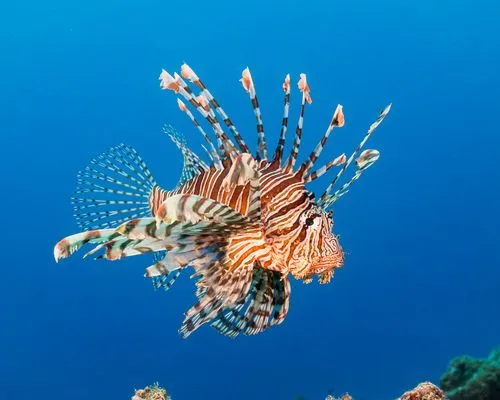
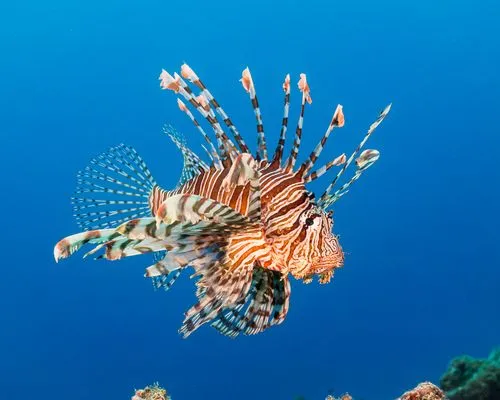
The lionfish is in no hurry. It hangs almost motionless in the water, its fins spread like a fan, and lets you come closer than most other fish. That is exactly what makes it tricky – not for the reef, but for hands that get curious. There is venom in the long rays of its fins.
In the MarineDex, the species profile says it plainly: “Venomous spines, slow hunter.” Two traits that belong together. An animal that can defend itself this well has no need to flee.
Venomous Doesn’t Mean Aggressive
Most venomous animals on the reef use their venom to defend themselves. A lionfish doesn’t hunt divers, and a stingray doesn’t sting on a whim. Accidents almost always go the same way: a hand reaches for a rock, a knee lands in the sand, a fin brushes the coral. The animal reacts to being touched – not to your presence.
That is the good news. If you don’t touch anything, you have already ruled out the biggest risk.
Who Deserves Distance in the MarineDex
Some of the species you can collect in the MarineDex deserve a particularly close look – from a distance:
- Lionfish and devil firefish: venomous spines in the fins. Both often stay put instead of swimming away.
- Stingray: a venomous spine on the tail. The animal likes to lie buried in the sand and is then almost impossible to see.
- Long-spined sea urchin: extremely long, fine spines. Usually in crevices by day, out and about at night.
- Fire coral: looks like a harmless coral, but burns on contact with the skin.
- Crown-of-thorns starfish: large starfish with long, venomous spines.
- Cone snails: beautiful shells – and a venom apparatus they use to hunt. That is why you never pick up a snail shell.
- Blue-ringed octopus: small and highly venomous. It shows its bright blue rings when it feels threatened.
- Sea snake: highly venomous, but usually calm. It has to come to the surface to breathe – never cut off its path.
- Nudibranchs: Many carry conspicuous warning colors. That is exactly what they are: a warning.
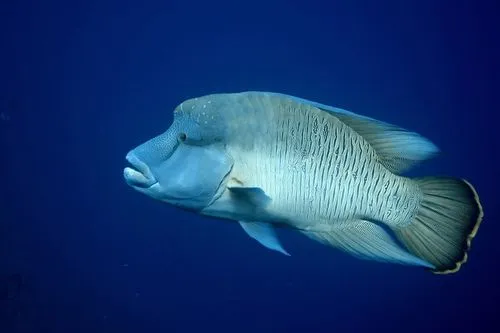
No venom, but still a reason for respect: the titan triggerfish defends its nest during the breeding season. Its territory extends upward in a cone shape. If you are attacked, swim away sideways – not toward the surface.
It pays to read up before the dive: in the MarineDex, a species profile also describes its behavior – for the blue-ringed octopus, for example, “Highly venomous, shows blue rings when in danger”.
Six Rules for Keeping Your Distance
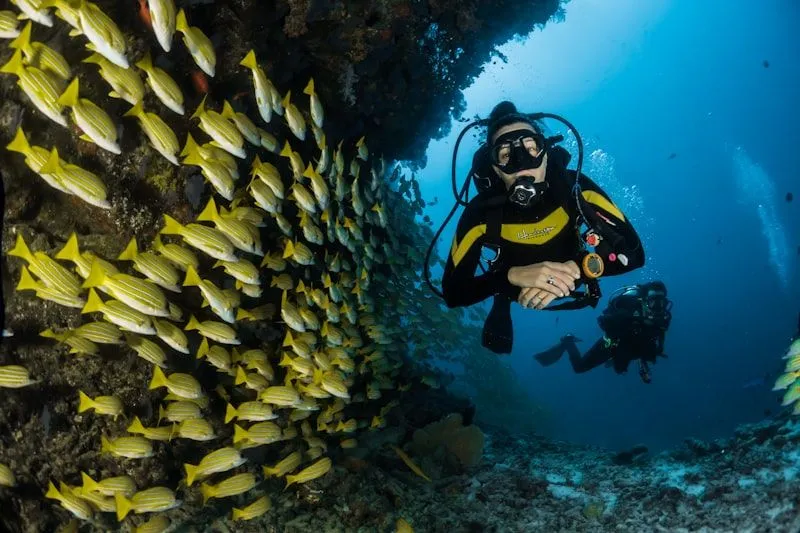
- Buoyancy first. Most contact happens by accident. If your buoyancy is under control, you don’t kneel in the sand or flail your arms.
- Keep your hands to yourself. Arms relaxed in front of your body or folded – then they won’t reach for the reef out of reflex.
- Look first, then steady yourself. If there is really no other way: one finger on bare rock that you have looked at closely beforehand. Scorpionfish and stonefish are masters of camouflage.
- Not from above, not head-on. Approach slowly and from the side. Leave every animal an escape route.
- Take nothing, feed nothing. No snail shell, no mussel, no bread for the fish.
- Watch your fins. Especially when taking photos, it is easy to forget where your own fins are. One fin kick too deep stirs up sand – or hits a coral.
For beach entries there is a rule of its own: in shallow, sandy water, shuffle your feet along the bottom instead of stepping down. That gives a buried stingray time to move away before you step on it.
Distance Protects the Reef Too
“Don’t touch” doesn’t only apply to venomous animals. Corals are living creatures, and even a single touch can damage their delicate mucus layer. Stirred-up sand settles on the reef. And animals that are constantly crowded retreat.
Keeping your distance is therefore not a precaution for beginners, but part of a good dive – no matter how many dives you already have in your log.
What Counts for the MarineDex Is What You See
AquorDex is built so that getting close doesn’t pay off. You unlock a species because you saw it – not because you got especially close to it. A photo from a safe distance lifts it to the “Photographed” level just as much as a close-up does. And XP depend on the rarity of the species, not on the distance.
So there is no reason to put a hand on the reef for the perfect shot. Patience usually gets you better photos than proximity: if you hover calmly in the water, many animals come to you on their own.
If Something Does Happen
After a sting or an injury: end the dive calmly, inform your buddy and dive guide, and get medical help. With a blue-ringed octopus, cone snail or sea snake, any bite or sting is an emergency – call emergency services immediately.
What exactly to do is something you learn in a first aid course for divers. AquorDex replaces neither that training nor the briefing from your dive center. It only helps you get to know the animals before the dive.